


The Role of Government Permits in Gold Exports
Government export permits are not administrative formalities—they are mandatory legal gateways that determine whether gold can legally leave African territories. Without valid permits physically verified against material, airlines will not accept cargo and destination customs will reject shipments. Understanding this checkpoint protects buyers from non-delivery risk and compliance exposure.
Why Permits Exist
Permits serve three critical functions:
- Revenue assurance: Confirming mineral royalties and export duties are paid before material departs
- Supply chain oversight: Verifying material originates from licensed operations rather than illicit sources
- International compliance: Providing documentation required by destination markets under OECD and LBMA standards
These functions make permits non-negotiable—regardless of gold purity or buyer relationships.

Ghana’s PMMC Permit System
Ghana requires Precious Minerals Marketing Company approval for all gold exports. PMMC officials conduct side-by-side verification: comparing fire assay certificates from accredited laboratories against physical material before issuing permits. Permits include batch-specific identifiers, weight declarations, and validity periods typically limited to 14 days. Airlines at Kotoka International Airport will not accept cargo without original PMMC permits physically presented at check-in.
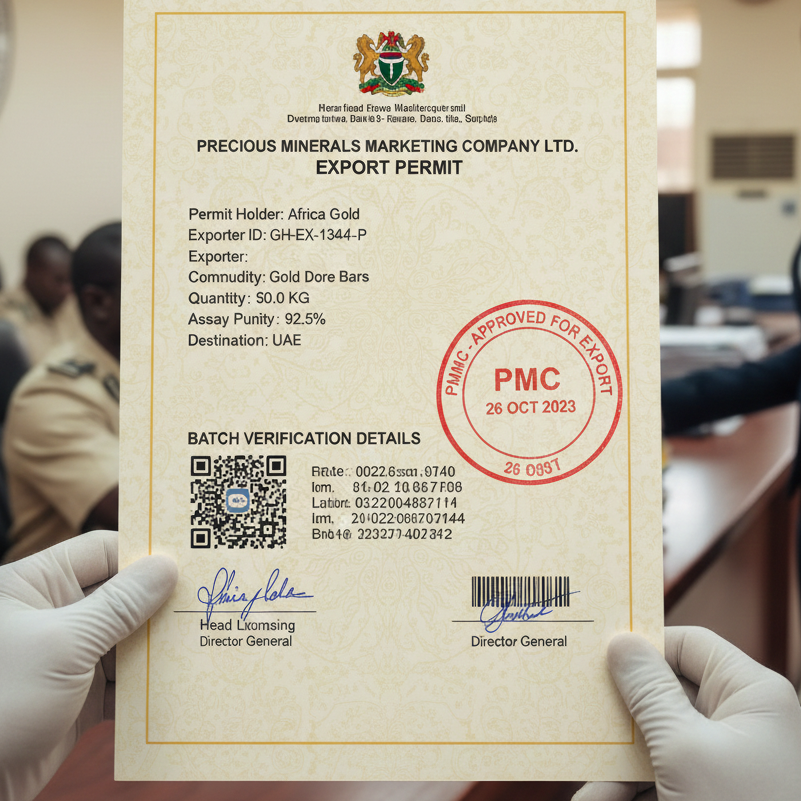
Image: PMMC permit with official approval stamp and batch verification details
South Africa’s Dual Authorization Framework
South Africa mandates dual clearance: the South African Diamond and Precious Metals Regulator issues export permits after verifying SABS fire assay results, while SARS customs provides separate endorsement at OR Tambo International Airport. Both stamps must appear on documentation before airline acceptance. This layered verification reflects South Africa’s mature regulatory infrastructure and integration with national revenue systems.

Image: SADPMR permit with visible SARS customs endorsement stamp
South Sudan’s Dual Ministry Requirement
South Sudan enforces approval from both the Ministry of Mining (verifying source legitimacy) and Ministry of Finance (confirming tax compliance). Officials conduct joint inspections at Juba International Airport before clearing shipments. This dual-signature requirement creates additional processing time but provides commercial assurance that material has passed both technical and fiscal verification.
Image: Dual ministry signature block on South Sudan gold export permit
Permit Timing and Transaction Security
Legitimate exporters secure permits before requesting buyer payment. This sequencing protects buyers from funding shipments that cannot legally export. Red flag transactions reverse this order—requesting payment before permit issuance—creating non-delivery risk if permits are denied due to documentation gaps.
Since 2015, AFRICA GOLD has maintained permanent field teams across Ghana, South Africa, and South Sudan from its South African headquarters, with coordination support from the United Kingdom. The company navigates permit processes directly—submitting applications with complete documentation packages, attending physical inspections, and securing approvals before payment requests—ensuring buyers fund only legally exportable material.

Government permits transform gold from locally sourced material into legally exportable assets. Partner with an exporter who secures permits before payment requests and maintains transparent documentation throughout the approval process.
africa-gold.com
sales@africa-gold.com