
Africa Gold Production by Country – 2026 Rankings and Strategic Insights
Africa remains a dominant force in global gold supply, producing nearly 25% of the world’s annual output—approximately 900–950 tonnes in 2026. Production is concentrated in a handful of countries with favorable geology, regulatory frameworks, and mining infrastructure. Below is a detailed breakdown of Africa gold production by country, based on data from the World Gold Council, national mining ministries, and company disclosures.
Top 10 Gold-Producing Countries in Africa (2026 Estimates)
| Rank | Country | Annual Production (Tonnes) | Key Features |
|---|---|---|---|
| 1 | Ghana | ~190 | Africa’s top producer; transparent PMMC export system; Birimian Greenstone Belt |
| 2 | South Africa | ~150 | Largest reserves (~2,000+ tonnes); Witwatersrand Basin; deep-level mining |
| 3 | Mali | ~120 | High-grade Loulo & Fekola mines; OECD-aligned reforms |
| 4 | Burkina Faso | ~115 | Rapid growth despite security challenges; major Endeavour Mining operations |
| 5 | Tanzania | ~50 | Stable output; Geita, North Mara mines; improved mining code |
| 6 | Côte d’Ivoire | ~45 | Fast-growing sector; new discoveries in Birimian Belt |
| 7 | Democratic Republic of Congo (DRC) | ~35–80* | High potential but significant informal/conflict-linked flows |
| 8 | Zimbabwe | ~30 | Greenstone belt deposits; formalization efforts underway |
| 9 | Sudan | ~25–30 | Nubian Shield geology; export mostly via UAE; compliance risks |
| 10 | South Sudan | ~5–10 | Emerging frontier; new mining law enabling compliant exports |
*DRC figures vary widely due to informal trade; official exports understate true output.
Image: Bar chart showing Africa’s top gold-producing countries by volume (2026)
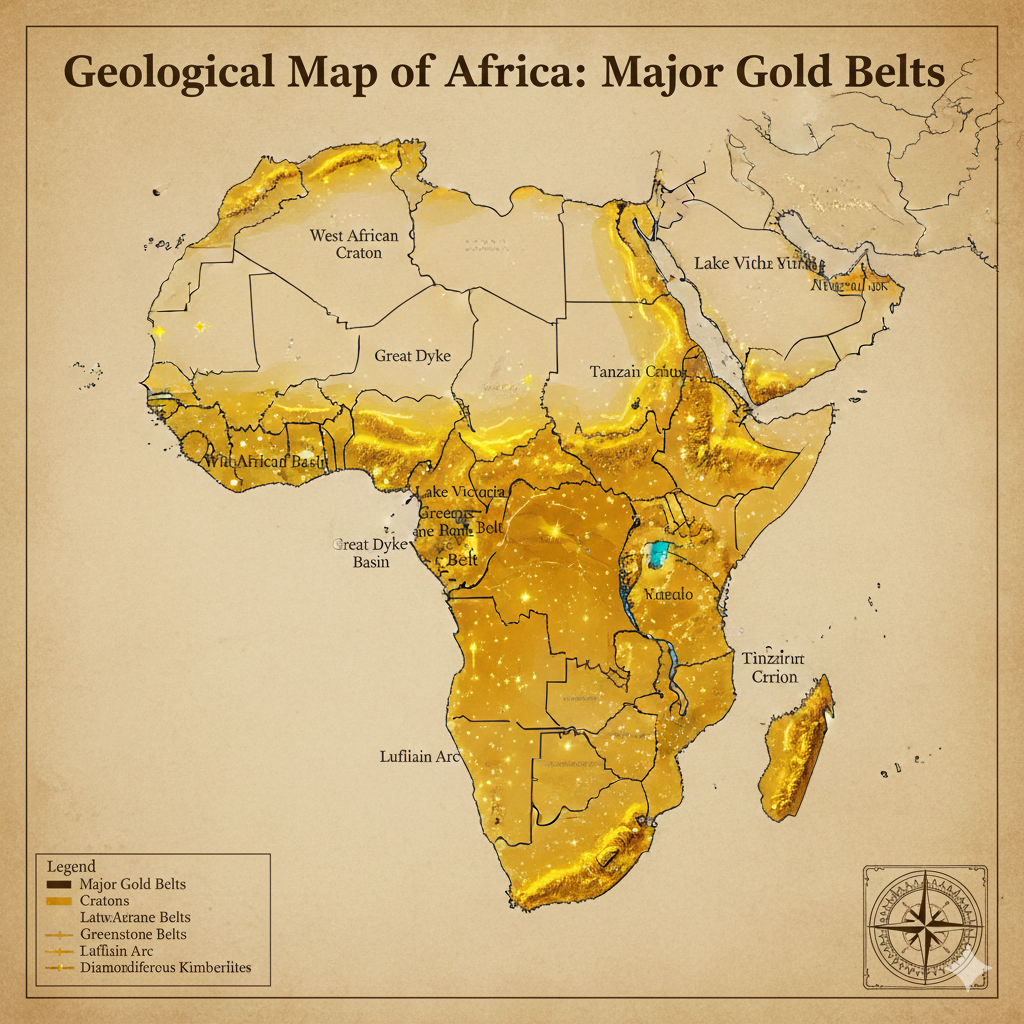
Geological and Operational Context
- West Africa (Birimian Belt):
Spans Ghana, Mali, Burkina Faso, and Côte d’Ivoire. Hosts high-grade, near-surface deposits ideal for open-pit and artisanal mining. Accounts for over 60% of Africa’s total production. - Southern Africa (Witwatersrand Basin):
South Africa’s paleoplacer deposit remains the world’s largest known reserve. Mines like Mponeng (>4 km deep) continue to produce despite rising costs. - East & Central Africa:
Includes Tanzania, DRC, and Sudan—rich in alluvial and hard-rock gold but challenged by governance, infrastructure, and conflict risks.
Image: Geological map of Africa’s major gold belts
Formal vs. Informal Production
- Industrial Mines: Operated by majors like Gold Fields, AngloGold Ashanti, and Barrick—account for ~65% of output.
- Formalized Small-Scale Miners: Registered cooperatives (e.g., 1,000+ in Ghana) contribute ~30–35%.
- Informal Miners: Estimated 5–10%—often excluded from compliant supply chains due to lack of documentation.
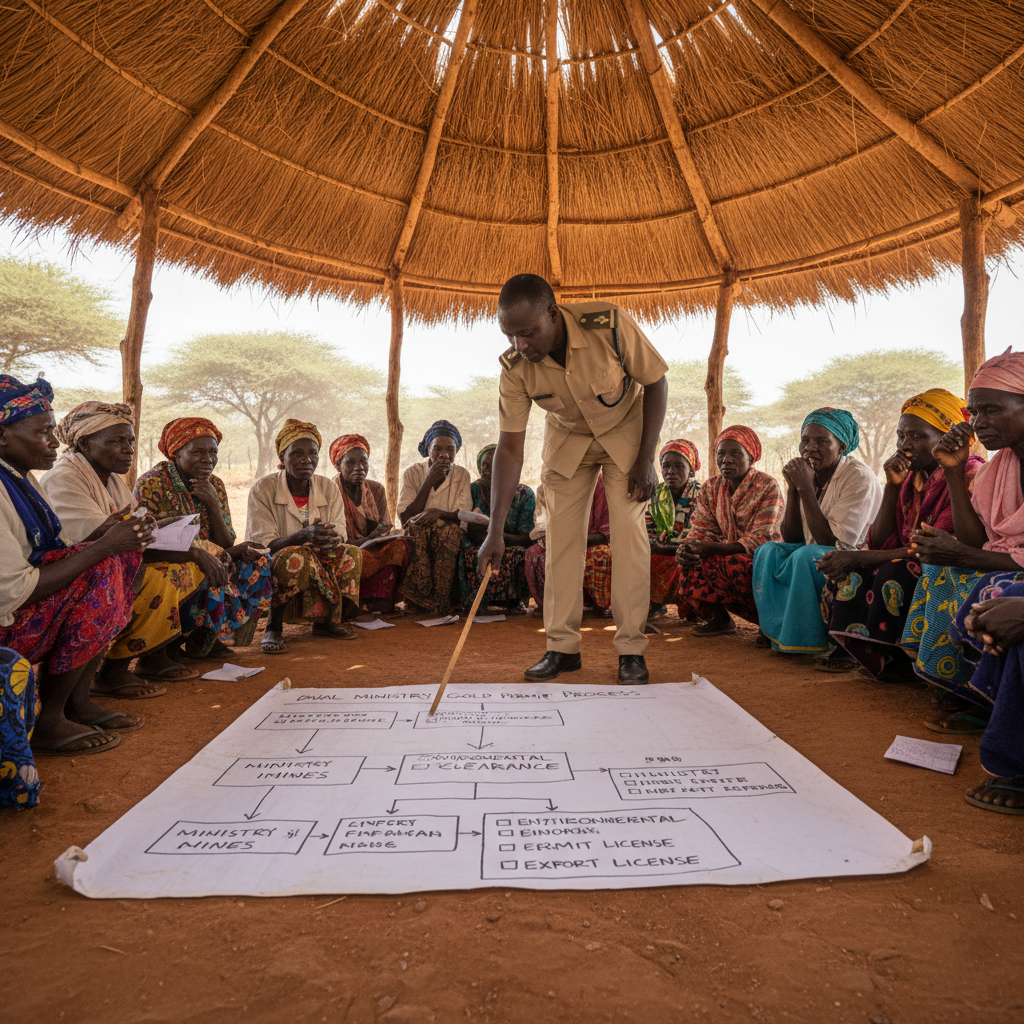
Governments are increasingly formalizing artisanal sectors to improve safety, revenue collection, and environmental standards.
Compliance and Export Readiness
Leading producers are aligning with global standards:
- Ghana: All licensed exports reported via PMMC with real-time traceability.
- South Africa: Enforces FICA and Mining Charter compliance.
- Mali & Burkina Faso: Require environmental and community agreements.
- OECD Due Diligence Guidance: Now adopted across formal supply chains.
This enables African gold to meet LBMA Responsible Gold requirements for refiners in Dubai, Zurich, and New York.
Africa Gold Reserve’s Operational Focus
Founded in 2015 and headquartered in South Africa, Africa Gold Reserve sources gold exclusively from:
- Ghana: Licensed aggregators in Ashanti and Western regions
- South Africa: Formal small-scale miners in Mpumalanga and Limpopo
- South Sudan: Vetted suppliers under new regulatory framework
The company does not operate in high-risk jurisdictions without verifiable compliance systems.
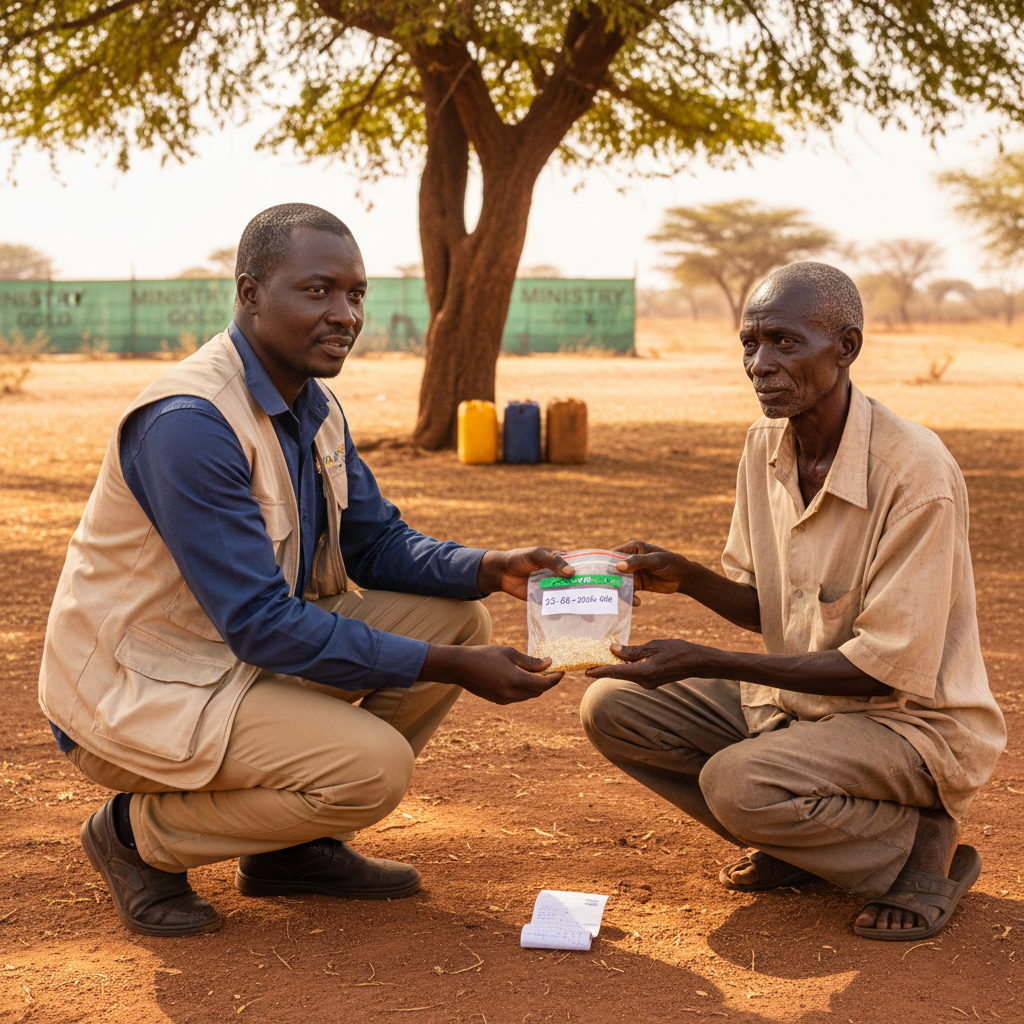
Image: Field technician conducting real-time gold purity test using calibrated XRF device
Conclusion
Africa’s gold production is led by a core group of stable, high-output nations—primarily in West and Southern Africa. For institutional buyers, the focus is not just on volume, but on verifiable, ethical sourcing. Partnering with a professional exporter like Africa Gold Reserve ensures secure access to compliant gold from the continent’s most strategic and responsible jurisdictions.
Website: africa-gold.com
Email: sales@africa-gold.com