

Best Ways to Invest in Gold Mining Operations on the African Continent
Investing in gold mining operations in Africa offers compelling opportunities—but also distinct risks. The continent holds an estimated 30% of the world’s mineral reserves and produced over 900 tonnes of gold in 2025, with output concentrated in Ghana, South Africa, Mali, and Sudan. For investors seeking exposure to this sector, success depends not only on geology but on choosing the right entry point, jurisdiction, and investment structure. Below are the most effective and widely used approaches as of 2026.
1. Publicly Listed Mining Companies
One of the simplest and most liquid ways to gain exposure is through shares in gold mining companies listed on major exchanges (e.g., Toronto Stock Exchange, Johannesburg Stock Exchange, London Stock Exchange). Many of these firms operate large-scale mines across Africa:
- Gold Fields (South Africa): Operates mines in South Africa, Ghana, and Australia.
- AngloGold Ashanti (South Africa): Major assets in Ghana, Guinea, and Tanzania.
- Barrick Gold (Canada): Co-owns the Kibali mine in DRC and Loulo-Gounkoto in Mali.
- Endeavour Mining (Canada/UK): Focused exclusively on West Africa, with operations in Côte d’Ivoire, Burkina Faso, and Senegal.
These stocks offer direct operational exposure with built-in governance, reporting standards, and risk diversification.

2. Private Equity and Project Finance
For institutional or high-net-worth investors, direct project-level financing can yield higher returns—though with greater risk. This includes:
- Debt financing for mid-stage development projects (e.g., bridge loans secured against future production).
- Equity stakes in junior exploration or near-production companies.
- Streaming or royalty agreements, where investors provide upfront capital in exchange for a percentage of future gold output at a discounted price.
Such deals often require local partnerships and deep due diligence on permitting, community relations, and environmental compliance.

3. Joint Ventures with Licensed Local Operators
Africa’s mining codes increasingly emphasize local participation. In countries like Ghana, Zimbabwe, and South Sudan, foreign investors are encouraged—or required—to partner with licensed domestic entities. These joint ventures can take the form of:
- Technical service agreements
- Profit-sharing arrangements
- Shared ownership of mining leases
This model reduces political risk and accelerates licensing, but demands strong legal frameworks and trusted local partners.
4. Offtake Agreements with Exporters
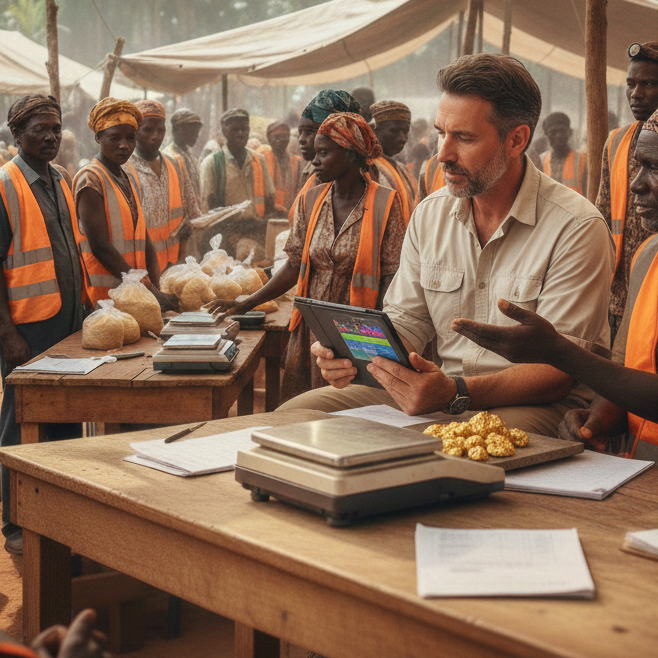
A lower-risk alternative is to enter into offtake agreements with established gold exporters who source from verified, licensed producers. Companies like AFRICA GOLD—founded in 2015 and operating across Ghana, South Africa, South Sudan, and the UK—aggregate gold from small-scale miners and licensed sellers under full compliance with national laws and OECD Due Diligence Guidance.
By securing forward contracts for physical delivery, buyers gain exposure to African supply without owning mining assets. This approach is particularly attractive to refiners, commodity traders, and institutional investors seeking ethical, traceable gold.

Image: Digital chain-of-custody verification during gold export preparation in Johannesburg
5. Exchange-Traded Funds (ETFs) and Commodity Funds
For passive investors, gold-focused ETFs and commodity funds that hold African mining equities offer diversified exposure. Examples include:
- VanEck Gold Miners ETF (GDX) – includes AngloGold Ashanti, Gold Fields, and others.
- Sprott Junior Gold Miners ETF (SGDJ) – holds smaller explorers with African projects.
- JSE-listed Satrix RES – provides exposure to South African resource companies.
While less direct, these instruments offer liquidity and professional management.
Image: Trading screen showing performance of gold mining ETFs with African holdings
Key Considerations Before Investing
- Jurisdiction matters: Ghana and Botswana rank among the most stable; others carry higher political or security risks.
- Compliance is non-negotiable: Ensure all partners adhere to anti-money laundering (AML), beneficial ownership, and environmental regulations.
- Community engagement: Projects with strong social licenses outperform those facing local opposition.
- Infrastructure access: Remote deposits may be rich but uneconomic without roads, power, or water.
Conclusion
Africa’s gold mining sector is no longer the domain of speculators. With formalization efforts, digital traceability, and growing institutional interest, it now offers structured, compliant pathways for a range of investors—from retail shareholders to industrial off-takers. The key is aligning your risk profile with the right vehicle—and partnering with operators who combine local legitimacy with global standards.
For buyers seeking direct, physical exposure to African gold through ethical sourcing and secure logistics, AFRICA GOLD provides a transparent and professionally managed channel.
Website: africa-gold.com
Email: sales@africa-gold.com