

How African Gold Reaches Global Refineries
Introduction
The journey of African gold from mine to international refinery is a tightly coordinated process blending local expertise, regulatory compliance, and secure logistics. It is not a simple transaction but a multi-stage workflow where each step must align with national laws and global standards. For buyers and investors, understanding this pathway reveals why professional exporters are essential—and how legitimate supply chains operate in practice.

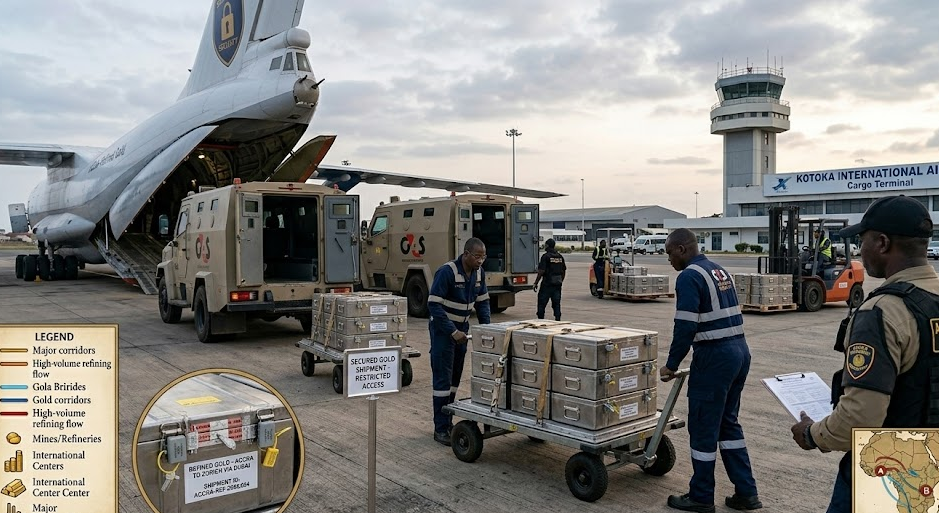
Image: Gold bars loaded onto aircraft cargo pallet
AI Image Prompt:
Photorealistic wide-angle shot inside active airport cargo hold at night. Two black security containers labeled with tamper-evident seals are being secured onto an aircraft pallet by handlers in high-visibility vests. Background shows curved fuselage interior with safety netting and distant ground crew. Harsh industrial lighting creates sharp highlights on container surfaces and deep shadows on metal floor. Shot on Sony A7SIII with 24mm lens at f/5.6, slight motion blur on handler’s arm suggesting real-time loading, authentic condensation on metal surfaces from temperature differential, cool blue-white color temperature typical of night operations, genuine aviation environment with visible rivets and panel seams.
From Mine to Collection Point
The process begins at licensed mines or registered small-scale operations in Ghana, South Africa, or South Sudan. Material is aggregated at secure collection points where exporters conduct initial verification. This includes visual inspection, preliminary XRF testing, and documentation of source legitimacy—such as miner registration cards or mine site permits. Only material with clear legal origin proceeds. Unverified or undocumented lots are rejected immediately, ensuring the chain of custody starts cleanly.
Image: Secure gold collection point in rural Ghana

Verification and Assay Certification
Once acquired, gold undergoes rigorous testing at nationally accredited laboratories. In Ghana, this means Minerals Commission-approved labs; in South Africa, SABS-registered facilities; in South Sudan, increasingly Dubai-linked or mobile accredited units. Fire assay determines final fineness, while weight is verified on calibrated scales. The resulting certificate—bearing unique serial numbers, purity, weight, and lab accreditation—becomes the foundation for all subsequent steps. Without it, no export permit can be issued.
Export Permit and Customs Clearance
Armed with assay certificates and proof of legal acquisition, exporters submit applications to national authorities. Ghana’s Precious Minerals Marketing Company reviews documentation before issuing permits. South Africa requires SADPMR approval and SARS customs declarations. South Sudan mandates dual ministry sign-offs. Once approved, customs officials inspect physical material against paperwork. Only after this final match is the shipment cleared for air freight. Any discrepancy halts the process immediately.
Secure Transit to Destination Refineries
Cleared gold is sealed in tamper-evident containers and transported directly to airport cargo facilities under armed escort or secure logistics protocols. Shipments move via commercial air freight on direct routes: Accra to New York, Juba to Dubai, Johannesburg to Shanghai. Air waybills include detailed descriptions, seal numbers, and consignee details. Insurance coverage is mandatory. Upon arrival, destination refineries inspect seals, verify documentation, and conduct their own intake assays before accepting material into processing.
AFRICA GOLD’s End-to-End Execution
Since 2015, AFRICA GOLD has managed this entire workflow across Ghana, South Africa, and South Sudan. The company sources only from licensed entities, verifies in person, uses accredited labs, secures permits directly, and oversees airport handover. Their trade corridors—South Sudan to UAE, Ghana to USA, South Africa to China—operate with consistent documentation and transit protocols aligned to refinery requirements. This end-to-end control ensures African gold reaches global refineries reliably, legally, and without delay.
Conclusion
African gold reaches global refineries through disciplined execution, not chance. It requires local presence, regulatory fluency, scientific verification, and secure logistics. Buyers who understand this process recognize that the exporter’s role is not brokerage but orchestration. When every stage—from mine verification to airport handover—is professionally managed, African gold becomes a seamless input into the world’s most sophisticated refining networks.
africa-gold.com
sales@africa-gold.com